


Four seasons turning in nature, four cardinal directions guiding our way, four phases of the moon, four suits in a deck of cards, and the four elements from which the world has long been thought to be made—throughout time, the number four has embodied order, stability, and a sense of completeness. The same quiet magic resides in music: four voices can engage in dialogue, form a cohesive whole, and yet allow every detail to shine. The quartet thus stands among the most enduring musical formations—whether a string quartet, where each instrument itself carries four strings, a vocal ensemble, or any combination of four instruments.
The fourth decade of the Concentus Moraviae Festival opens this year with a constellation of outstanding quartets from across the globe, each bringing the music of its homeland along with its distinctive interpretative voice. Alongside masterful string quartets, audiences will encounter other four-part ensembles—vocal, saxophone, clarinet, cello, and percussion—united by the same commitment to maintaining the delicate balance of four individual voices. This is an unprecedented celebration of quartet artistry and courage: to play in a quartet is to embrace closeness, to honour differences, and to create harmony—concentus. A quartet is not merely music; it is a relationship.
Following in the footsteps of the acclaimed dramaturgical partnerships of Jiří Beneš and Aleš Březina (2016: Shakespeare, Beethoven and the Czech Quartet Tradition) and Barbara Maria Willi and Tully Potter (2019: Concert of Nations), both devoted exclusively to string quartets, the 2026 edition—entitled Being the Quartet—is shaped by a team of four dramaturgs: Peter Jarůšek, Simone Gramaglia, Pavel Nikl, and David Dittrich. The latter brings extensive experience as a music organiser, complementing the quartet expertise of his three colleagues, all active and internationally acclaimed chamber musicians. Their collaboration results in a festival presenting the very pinnacle of quartet performance, taking place in more than twenty towns across the Vysočina and South Moravian regions, as well as Lower Austria, with special visits into the Olomouc and Zlín regions.
The festival’s ensemble-in-residence is the Pavel Haas Quartet, which also inaugurates the festival on 28 May 2026 in the historic hall of Slavkov–Austerlitz Castle. Their programme features Dvořák’s celebrated String Quartet No. 12 in F major, Op. 96, “American”, alongside the only string quartet by Vítězslava Kaprálová—an exceptional composer and one of the great hopes of early 20th-century Czech music, whose life was tragically cut short at the age of just twenty-five. The opening concert perfectly illustrates the festival’s dramaturgical concept: an emphasis on national repertoire, i.e. works by composers who are culturally and historically connected to the homelands of the individual ensembles. The audience can thus look forward to authentic and stylistically compelling interpretations of both well-known and lesser-known string quartet repertoire. Most of the invited quartets are made up of musicians of the same nationality; two ensembles, whose members come from different countries, will prepare for the festival a program composed of gems of the string quartet literature spanning multiple nations.
In addition to the ensemble-in-residence, the festival showcases a distinguished selection of today’s leading international string quartets, including Brooklyn Rider, Calidore Quartet, Schumann Quartet, Chiaroscuro Quartet, Quartetto di Cremona, Doric String Quartet, Danel Quartet, Leonkoro Quartet, Modigliani Quartet, Meta4, Apollon Musagete Quartet, Vision String Quartet, Bennewitz Quartet, and Zemlinsky Quartet. These established ensembles are joined by rising stars such as Quatuor Diotima, Fibonacci Quartet, Josef Suk Quartet, and Opus13—the Norwegian-Swedish ensemble awarded a performance at our festival as one of the principal prizes of the prestigious Wigmore Hall International String Quartet Competition, with which the festival has recently established a collaboration. Expanding beyond the traditional string quartet format, the programme also features Trio Bohémo joined by violist Avri Levitan, the saxophone ensemble BL!NDMAN [sax], and the vocal group Graindelavoix.
The dramaturgical team has also embraced the festival’s tradition of crossing into other genres. Vision String Quartet will reveal their alternative artistic profile, the much-loved Epoque Quartet and Clarinet Factory will return, and Cello Republic will make its festival debut. A rare guest appearance will come from the British Colin Currie Quartet, while cellist Ivan Vokáč will form a quartet together with the jazz trio KBŠ.
In several works, the equilibrium of the quartet is playfully “disrupted” by distinguished soloists: violist Pavel Nikl; cellists Peter Jarůšek and Lukáš Mareček; pianists Boris Giltburg and David Mareček; clarinettist Karel Dohnal; bassoonist Tomáš Františ; French horn player Přemysl Vojta; double bassist Petr Ries; and the singer Dasha. The closing concert features the Zemlinsky Quartet in a special programme with the outstanding soprano Simona Šaturová.
A new composition has once again been created for the festival; this time it will be Between Worlds by Pavel Klimashevsky, written for Ivan Vokáč and the KBŠ jazz trio. The work will receive its world premiere on June 16 in Hustopeče.
Alongside the concerts, the festival is also preparing a rich accompanying program. In Kroměříž, masterclasses for young string quartets will take place, offering inspiring encounters with experienced performers as well as being open to the public. These classes are organized in collaboration with the renowned Stauffer Academy in Cremona, Italy, where the festival prologue took place in April. The concert of four outstanding young quartets will be the culmination of these masterclasses, held from June 16 to 18 in Kroměříž, led by distinguished chamber music tutors Peter Jarůšek, Pavel Nikl, and Simone Gramaglia. From the Stauffer Academy, Arola Quartet and Quartetto di Genova will come to Kroměříž, while our festival has selected the Kubita Quartet and the Suk Quartet for this unique program.
Naturally, the festival program will also feature its popular traditional events, such as Music on Bikes, Golf for Music, and the opening of a site-specific art installation; all of these have their own dedicated section in the catalogue.
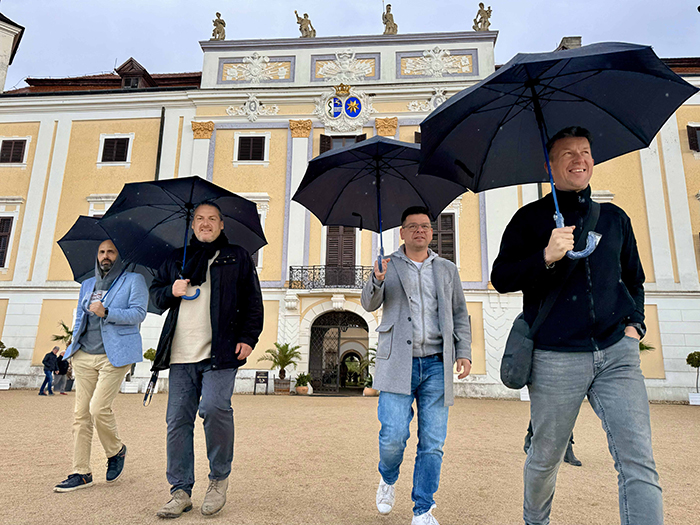
the dramaturgic team (from left): Simone Gramaglia, David Dittrich, Peter Jarůšek, Pavel Nikl
photo: Anežka Doleželová
hello